
 Tiếng
Việt
Tiếng
Việt
 Tiếng
Anh
Tiếng
Anh
 Tiếng
Nhật
Tiếng
Nhật



 Tiếng Anh


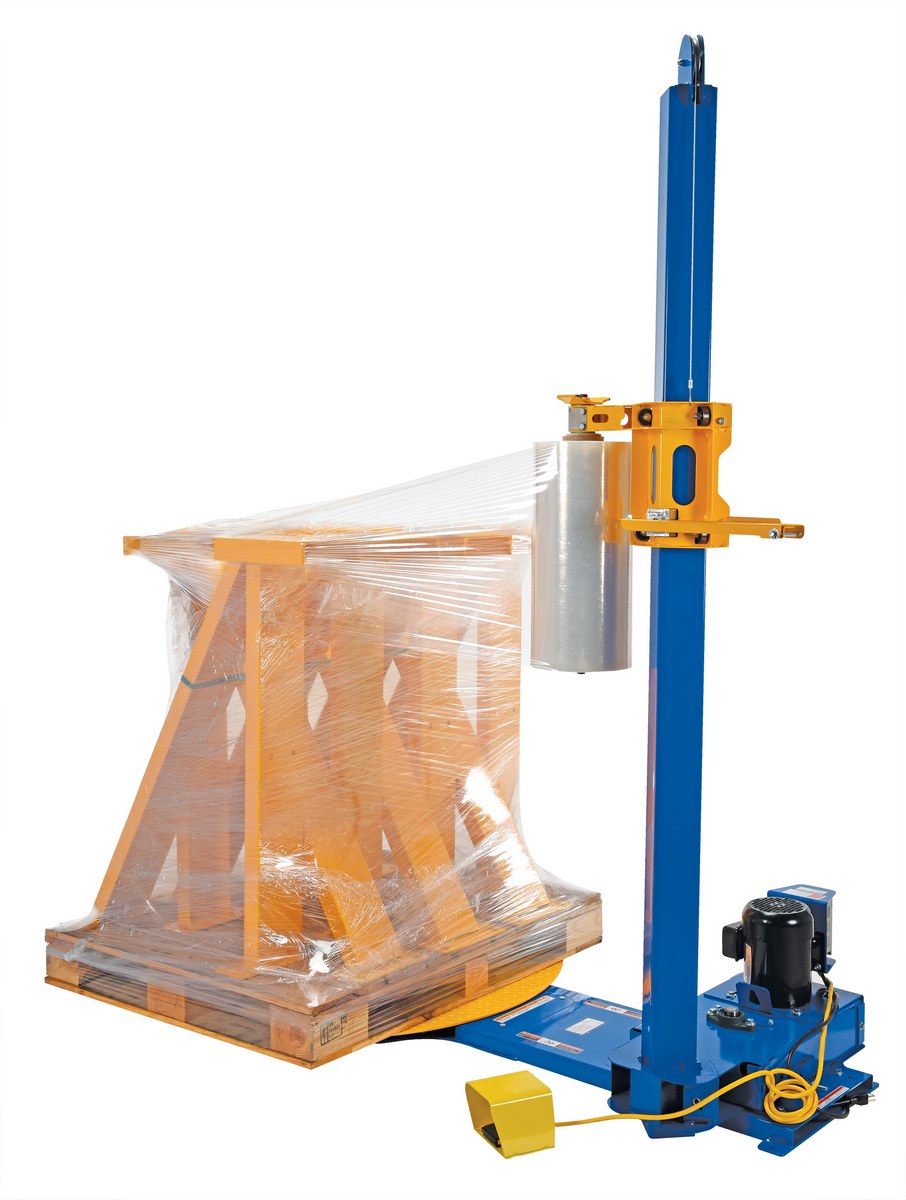
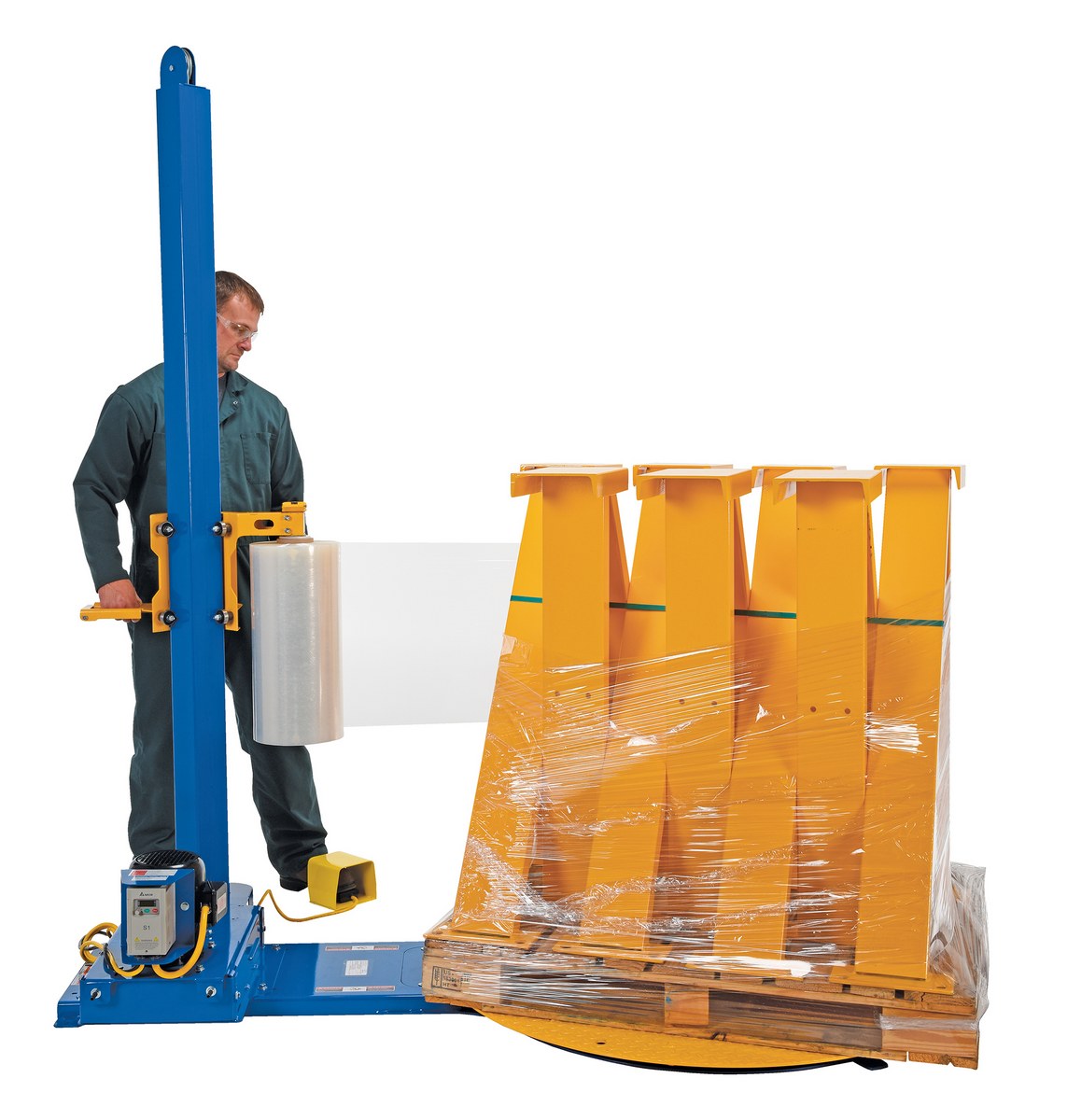
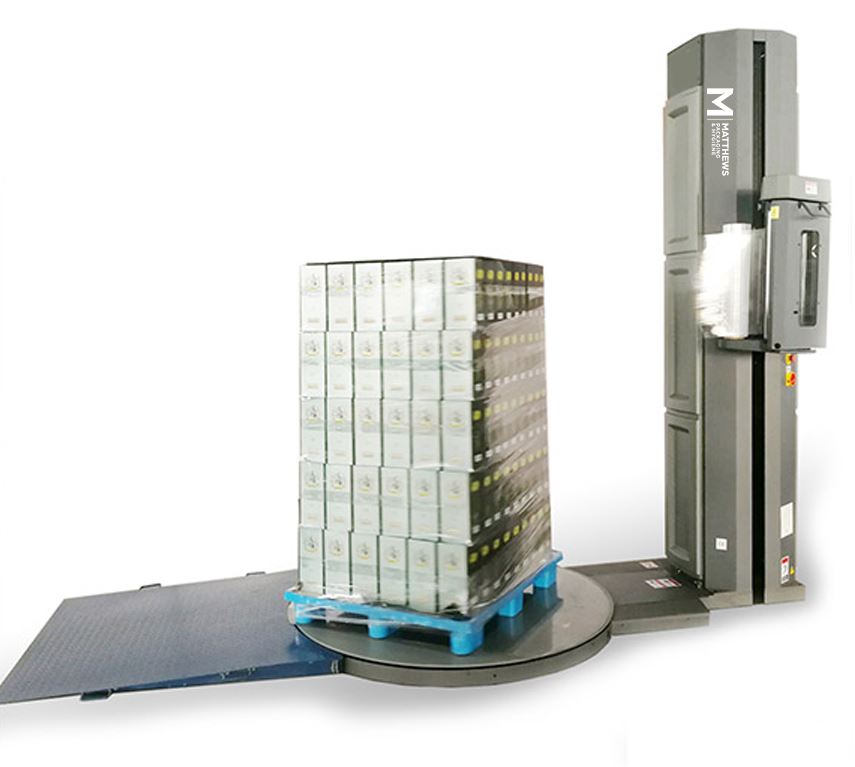
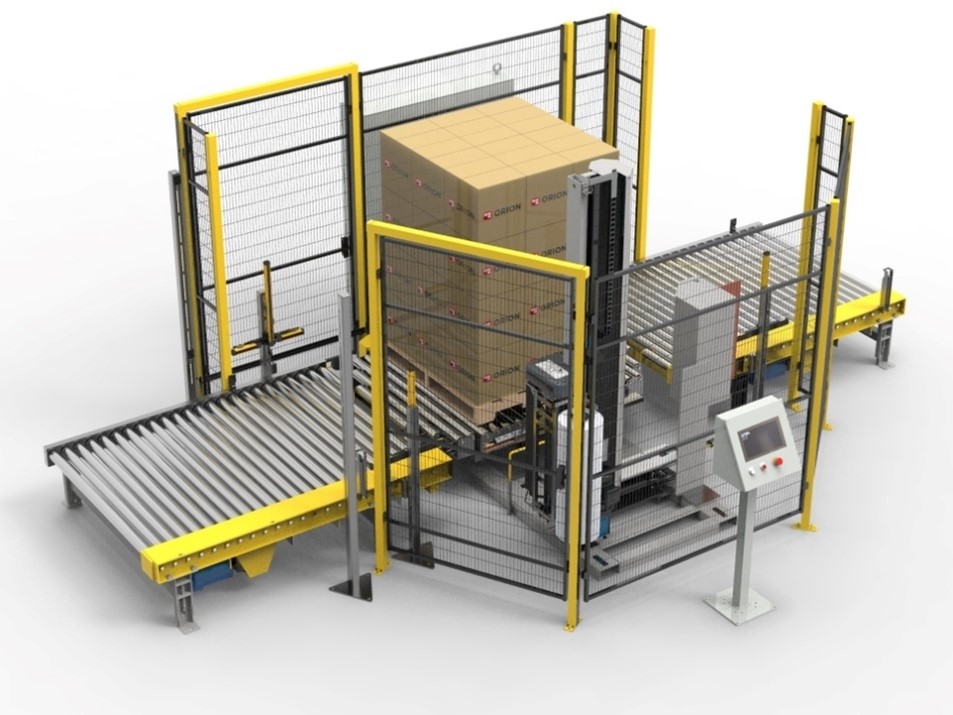
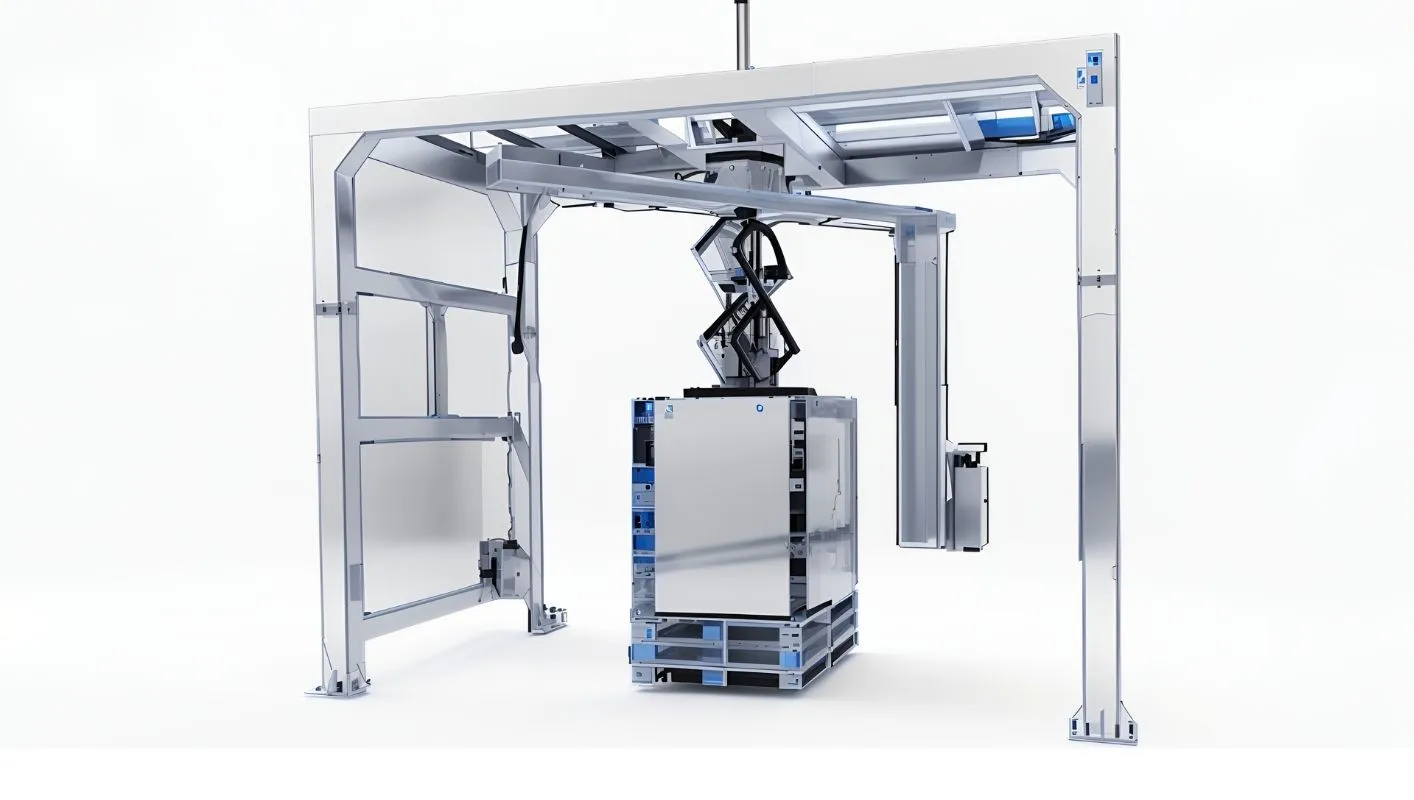
Industrial stretch wrapping machines
Stretch wrapping machine is an automatic device used to wrap and secure products on pallets for transportation or storage. These machines use a roll of stretch film, which is stretched and then wrapped around the pallet to hold the product in place. The stretch wrapping process involves placing the pallet on a turntable or conveyor belt, where it rotates while the stretch film is applied. The film is mechanically stretched when applied, which allows it to closely conform to the shape of the product on the pallet and create a strong, stable load.
VIETNAM CNC & TECHNOLOGY APPLICATION JOINT STOCK COMPANY
Hotline: +84.916 63 9355 / +84.915 74 4664
Email: Sales01@cncvina.com.vn / Sales03@cncvina.com.vn
Product description

Introduction to industrial stretch wrapping machines
Industrial stretch wrapping machines are automated systems designed to wrap and secure products on pallets for storage and transportation. The wrapping process uses a roll of stretch film, which is stretched and applied around the palletized load to hold the products securely in place. Depending on the machine configuration, the pallet may be placed on a turntable or transported by a conveyor while the stretch film is applied around the load. The film is stretched during the wrapping process, allowing it to conform closely to the shape of the palletized products and create a stable, secure load for handling, storage, and transportation. In this article, CNC VINA explores the main types of industrial stretch wrapping machines, along with the advantages and limitations of each configuration.
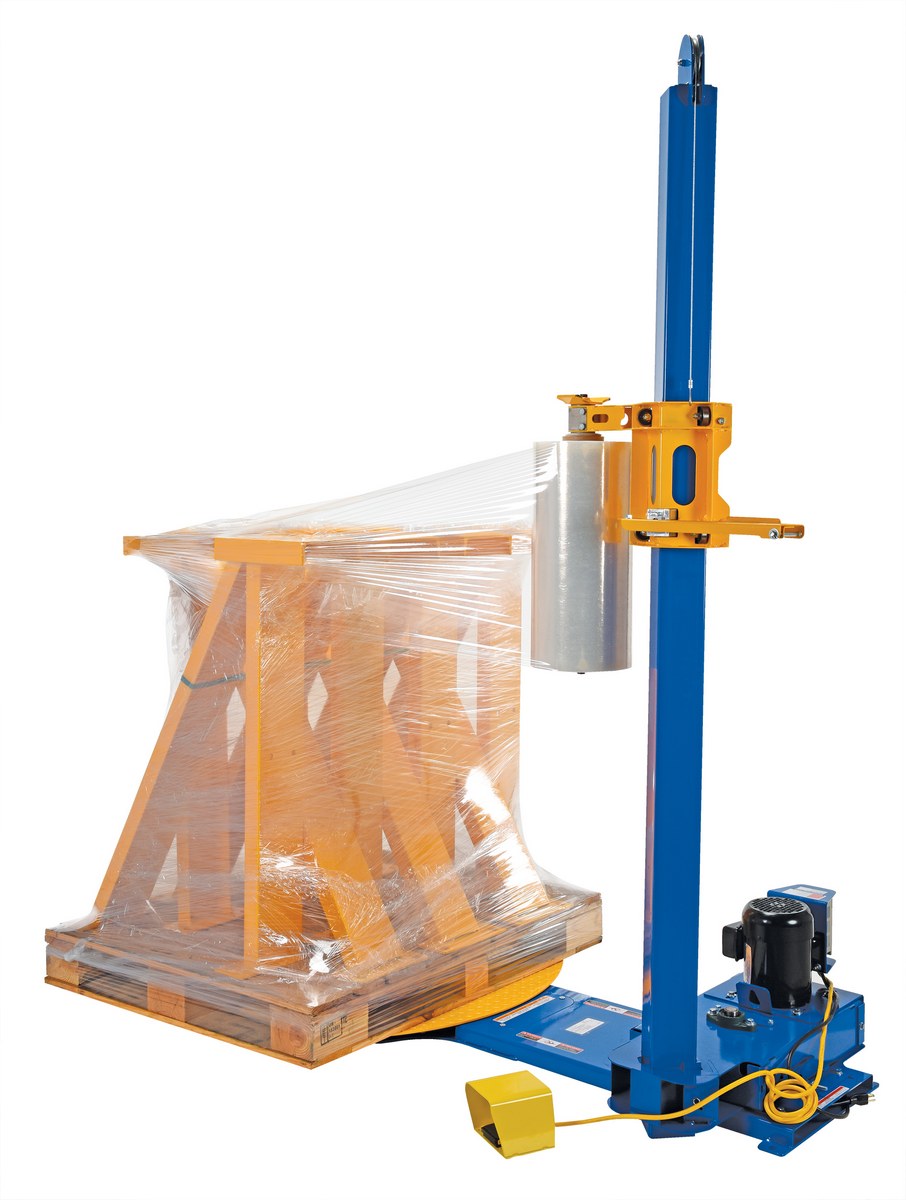
Technical specifications of the industrial stretch wrapping machine
| Specification | Details |
|---|---|
| Machine dimensions | L2650 × W1650 × H2895 mm |
| Power consumption | 1200 W |
| Power supply | AC 220V – 50 Hz |
| Wrapping capacity | 20–40 loads/hour |
| Turntable speed | 3–12 rpm |
| Turntable load capacity | 2000 kg |
| Turntable height | 78 mm |
| Turntable diameter | 1650 mm |
| Applicable product dimensions | L1200 × W1200 × H2400 mm |
| Machine weight | 500 kg |
Types of industrial stretch wrapping machines
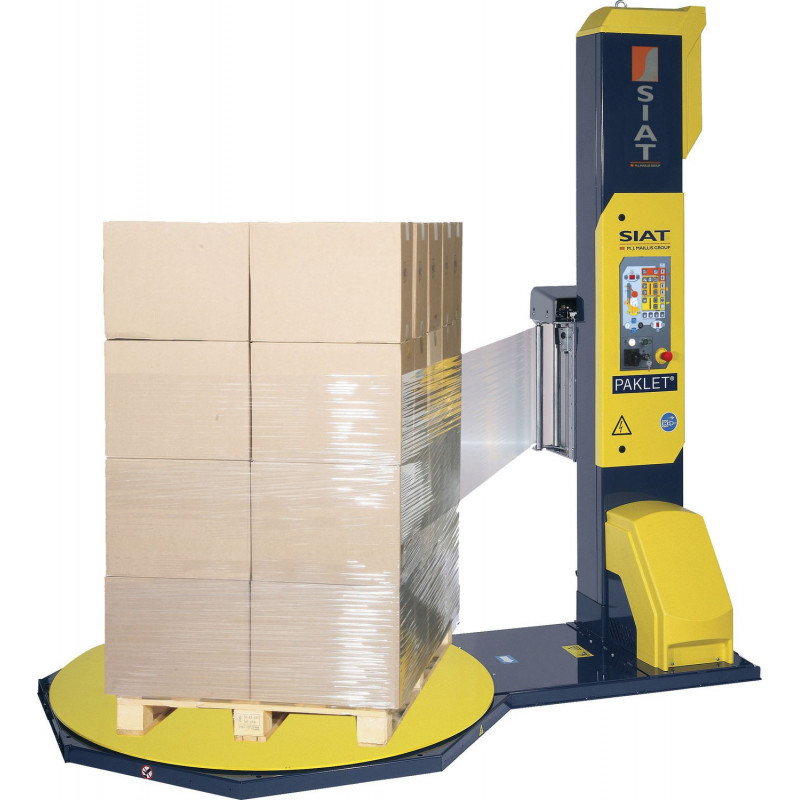
Turntable stretch wrapping machine
Operating principle
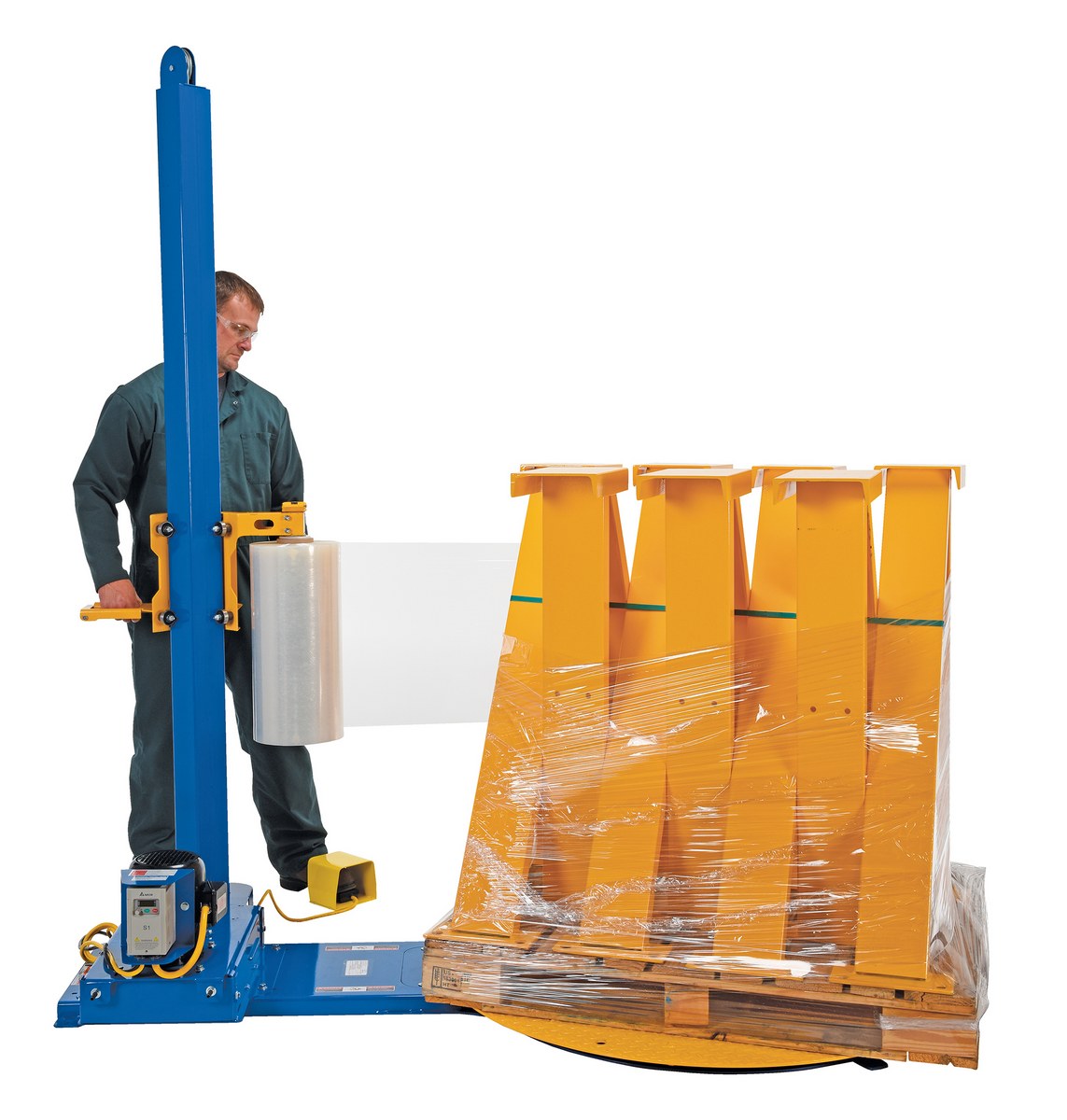
A turntable stretch wrapping machine uses a rotating turntable to rotate the pallet while a film carriage moves vertically along the height of the load. Before operation, the pallet is positioned at the center of the turntable, and the roll of stretch film is installed on the film carriage. Once the wrapping cycle starts, the turntable rotates while the film is fed and stretched, allowing the film to be applied evenly around the load.
Depending on the machine configuration, operators can adjust the turntable speed, film carriage travel speed, number of wrapping cycles, and film tension to suit the size, shape, and characteristics of different loads.
Features of a turntable stretch wrapping machine
A turntable stretch wrapping machine is designed to wrap palletized loads according to a preset cycle, providing greater control over key packaging parameters. The turntable speed and film carriage movement can be adjusted according to operating requirements, while parameters such as the number of wrapping cycles, wrapping height, and film tension can be configured based on the specific machine model. The control system allows operators to set and monitor the wrapping cycle, while protective mechanisms and safety functions are incorporated into the machine design. The equipment is also designed to facilitate inspection, cleaning, and routine maintenance during operation.
Reduced film consumption
Compared with fully manual pallet wrapping, a turntable stretch wrapping machine provides more consistent control over film tension and film consumption from one cycle to another. Models equipped with a pre-stretch system can stretch the film before it is applied to the load, helping make more efficient use of the film's properties and control material consumption.
The actual pre-stretch ratio depends on the machine configuration, type of stretch film, and packaging requirements. Therefore, the appropriate settings should be determined based on the specific application rather than applying a fixed ratio to all types of loads.
Improved wrapping consistency
One of the key advantages of a turntable stretch wrapping machine is its ability to standardize the wrapping process. Instead of relying entirely on individual operator technique, the machine follows predefined parameters, helping maintain relatively consistent film tension, number of wraps, and wrapping coverage from one pallet to another. This is particularly beneficial for production lines with high output or applications that require repeated wrapping of loads with the same specifications.
Improved load stability
During the wrapping process, the stretch film is applied around the pallet to create a holding force between the individual packages, helping reduce load movement during storage and transportation. Depending on the characteristics of the products, operators can adjust film tension, the number of wraps, and film distribution to suit each type of load. For pallets with different heights, weights, or load configurations, selecting the appropriate film and wrapping parameters is essential to maintain load stability without applying unnecessary pressure to the products or their packaging.
Applications of turntable stretch wrapping machines
Turntable stretch wrapping machines are commonly used in the final packaging stage, after goods have been consolidated and arranged on pallets for storage or transportation. The equipment is suitable for palletized loads consisting of stacked cartons, bags, or product packages with relatively consistent dimensions. The stretch film wrapped around the pallet helps secure the individual packages while providing an additional layer of protection against dust and moisture during storage, handling, and transportation. With the ability to handle loads of different sizes and weights within the machine's design capacity, turntable stretch wrapping machines can be applied across various industries, including paper manufacturing, food and beverage, ceramics, electrical and electronics, consumer goods, and other manufacturing sectors that require palletized packaging. For automated production lines, a turntable stretch wrapping machine can also be positioned at the end of the packaging process, downstream of strapping machines, conveyor systems, or robotic palletizers, depending on the overall line configuration and integration requirements.
Rotary arm stretch wrapping machine
Operating principle
A rotary arm stretch wrapping machine uses a rotating arm mechanism to apply stretch film around a pallet or load while the load remains stationary in the wrapping position. Before operation, the pallet is positioned in the wrapping area, and the film roll is installed on the film carriage mounted on the rotary arm. Once the wrapping cycle starts, the rotary arm moves around the load while the film carriage travels vertically along the height of the products, distributing the film from the bottom to the top of the load.
Depending on the machine configuration, the arm rotation speed, film carriage travel speed, number of wrapping cycles, and film tension can be adjusted according to specific packaging requirements. Once the preset number of wraps or wrapping height has been reached, the film carriage returns to its end position and the wrapping cycle is completed. The film is then held and cut by the integrated film cutting mechanism, preparing the machine for the next pallet. For models equipped with an automatic film clamping and cutting mechanism, the entire process can be carried out according to the programmed cycle without requiring the operator to handle the film directly at the wrapping position.
Features of a rotary arm stretch wrapping machine
A rotary arm stretch wrapping machine typically uses a PLC and HMI to control and configure operating parameters. Depending on the model, operators can set the number of wrapping cycles, arm rotation speed, film carriage travel speed, film tension, and other parameters according to the characteristics of each load. Photoelectric sensors may be used to detect the height of the load, helping the machine adjust the wrapping range according to the actual pallet dimensions. For operational safety, the machine may be equipped with warning lights, emergency stop buttons, and protective mechanisms appropriate to the design of each model.
The rotary arm is controlled according to a programmed sequence, with controlled acceleration and deceleration to help minimize sudden movements during operation. Some configurations also support both automatic and manual operating modes for machine setup, inspection, or maintenance. For the film delivery system, some models are equipped with a pre-stretch mechanism that stretches the film before it is applied to the load. This configuration helps provide more consistent control over film tension and material consumption between wrapping cycles. The pre-stretch level depends on the machine mechanism, type of stretch film, and packaging requirements. Therefore, the appropriate setting should be selected for each application rather than applying a fixed ratio to all types of loads.
The control system may also display operating status and fault alerts on the HMI. When a fault occurs, the corresponding information is displayed to help operators identify the machine status and carry out the necessary inspection procedures according to the technical instructions.
Increased packaging productivity
A rotary arm stretch wrapping machine can automate most operations in the pallet wrapping process, from film feeding and arm movement control to film application, wrapping completion, and cutting. Once the pallet is positioned correctly and the wrapping cycle is activated, the machine can complete the programmed wrapping sequence without requiring the operator to control each step manually. This helps reduce manual handling time and maintain a more consistent wrapping cycle, particularly when the machine is integrated with conveyors or automated pallet handling systems.
However, actual throughput depends on the duration of each wrapping cycle, pallet dimensions, load height, number of wrapping cycles, rotary arm speed, and the method used to supply and discharge pallets. Therefore, machine capacity should not be evaluated solely based on the maximum arm rotation speed.
Optimized packaging process
When integrated into an automated production line, a rotary arm stretch wrapping machine can be connected to conveyors, pallet transfer systems, or pallet handling equipment installed upstream and downstream of the wrapping station. The pallet is transferred into the wrapping position, the machine performs the programmed wrapping cycle, and the wrapped pallet is then transferred to the next stage. This configuration helps reduce manual pallet loading and unloading while creating a more continuous flow between palletizing and end-of-line packaging operations. For production lines with stable output, standardized wrapping parameters for each load type can also reduce dependence on individual operator techniques and help maintain consistent wrapping results from one pallet to another.
Controlled film consumption
Compared with fully manual wrapping, a rotary arm stretch wrapping machine provides greater control over film tension, the number of wrapping cycles, and the coverage area according to preset parameters. For models equipped with a pre-stretch mechanism, the film is stretched before being applied to the load, allowing the machine to make more effective use of the film's stretch properties and control film consumption during each cycle. Actual film savings depend on factors such as film type, pre-stretch ratio, load dimensions and characteristics, number of wrapping cycles, and the required level of pallet stability. Therefore, the film material and wrapping parameters should be selected according to the specific application rather than assuming that the machine will always use less film under all operating conditions.
Applications of a rotary arm stretch wrapping machine
Because the pallet and load remain stationary during the wrapping process, a rotary arm stretch wrapping machine is suitable for applications where rotating the entire load is impractical or could affect product stability. This configuration is particularly suitable for heavy palletized loads, tall loads, or products with irregular shapes that may shift when rotated.
During the wrapping process, stretch film is applied around the load to hold the packages together on the pallet, helping reduce load movement during storage, handling, and transportation. The film layer can also help limit direct exposure to dust and moisture, depending on the type of film used and the actual packaging conditions.
The machine can be applied across various industries, including industrial manufacturing, food and beverage, paper, ceramics, electrical and electronics, consumer goods, and logistics. In particular, a rotary arm stretch wrapping machine is worth considering for production lines that require pallet wrapping but are not well suited to rotating the load on a turntable, such as applications involving large loads, high centers of gravity, or loads that need to remain stationary throughout the packaging process.
Ring stretch wrapping machine
Operating principle
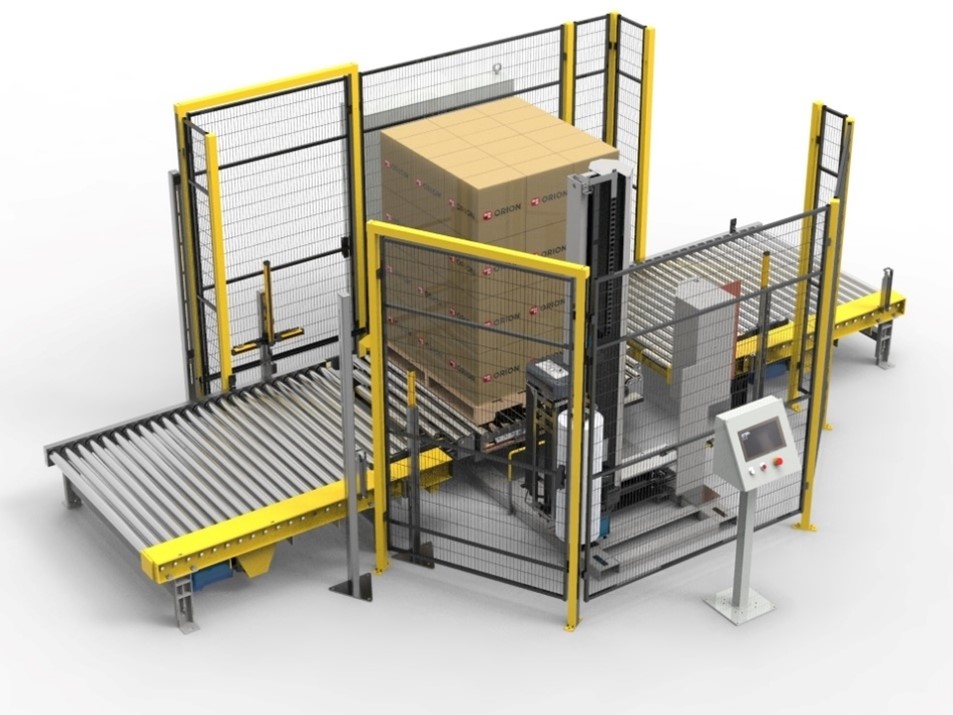
The product is transferred into the wrapping area by conveyor and positioned at the wrapping station. During operation, the wrapping unit rotates around the product while the lifting mechanism adjusts the position of the film roll according to the height of the load. The combination of rotational and vertical movement allows the stretch film to be distributed relatively evenly over the surface to be wrapped.
The wrapping speed, film carriage travel speed, and number of wrapping cycles can be configured according to the characteristics of each load. Once the wrapping cycle is completed, the system performs the finishing and film cutting operations before the product is transferred to the next stage.
Key features
Flexibility for different load sizes and characteristics
The machine can be configured according to the size and characteristics of the products within its designed operating range. Parameters such as load height, wrapping area dimensions, and operating mode can be determined based on the actual requirements of the production line. This allows the equipment to handle loads with different sizes and shapes rather than being limited to a single product specification.
Adjustable wrapping speed
The conveyor speed and rotational speed of the wrapping unit can be adjusted according to the requirements of each application. Controlling these parameters helps balance cycle time, load stability, and film consumption. For products with different characteristics, wrapping parameters can be configured separately to meet specific packaging requirements.
Automated wrapping cycle
The machine can perform the wrapping cycle according to preset programs, including film feeding, wrapping around the load, cycle completion, and film cutting. Depending on the level of automation required for the production line, the equipment can be configured for semi-automatic or fully automatic operation. When integrated with automatic product feeding and conveying systems, the machine can reduce manual handling at the packaging stage and maintain a more consistent operating cycle.
Adjustable number of wrapping cycles
The number of wrapping cycles can be set according to the characteristics of each load and its protection requirements. Controlling the number of wraps allows manufacturers to determine the required level of coverage and film consumption for each cycle more precisely.
PLC-based control
The control system uses a PLC to manage machine parameters and operating sequences. Operators can configure the required parameters for each wrapping mode while monitoring the equipment's operating status. The use of a PLC also facilitates integration with other equipment within an automated production line.
Convenient maintenance
The mechanical assemblies, drive components, and control system are arranged to facilitate routine inspection and maintenance. Performing scheduled maintenance helps maintain stable operation and minimize unplanned downtime. Actual maintenance requirements and intervals depend on the equipment configuration, operating frequency, and environmental conditions of each production line.
Throughput and production line integration
A ring stretch wrapping machine is suitable for applications with high packaging frequency and continuous operating requirements. Instead of placing each product on a turntable, the wrapping unit moves around the load while the product remains stationary or moves according to the configuration of the production line. When integrated with conveyors and automatic product handling systems, the machine can perform the wrapping process continuously, reducing waiting time between products and minimizing dependence on manual operations.
Actual throughput depends not only on the rotational speed of the wrapping unit but also on load dimensions and height, number of wrapping cycles, conveyor speed, product feeding method, and the processing time required before and after wrapping. Therefore, the machine configuration should be selected based on the actual throughput requirements of each production line.
Stable wrapping for lightweight or irregularly shaped loads
The ring wrapping mechanism allows the film to be distributed around the product through rotational movement, making it suitable for various loads with different weights and shapes. For lightweight or irregularly shaped products, controlling the wrapping speed and film tension helps reduce the risk of loose, misaligned, or uneven wrapping. For each product type, the film tension and number of wrapping cycles should be configured appropriately to ensure sufficient load securing during storage and transportation.
Optimized film consumption and operating costs
Controlling the number of wrapping cycles, wrapping speed, and film tension gives manufacturers greater control over packaging material consumption. The machine can help reduce unnecessary film usage caused by excessive wrapping while maintaining a consistent protective layer around the product. When operated and configured according to the characteristics of the load, an automated stretch wrapping solution can help reduce manual handling, maintain consistent packaging quality, and improve the efficiency of the end-of-line packaging process.
Suitable applications
A ring stretch wrapping machine is suitable for automated packaging lines with high processing speed requirements, particularly for products that need to be secured or protected with stretch film during transportation and storage.
Suitable product groups may include:
- Cylindrical components that require protective film wrapping while positioned vertically.
- Box-shaped products or packages with sufficient structural stability to remain secure during wrapping.
- Loads with relatively consistent dimensions and shapes that require high-frequency packaging.
- Automated packaging lines that require the wrapping machine to be integrated with conveyors and upstream or downstream equipment.
The appropriate machine configuration should be selected based on product dimensions, weight, shape, required number of wrapping cycles, and the actual throughput requirements of the production line.
Horizontal stretch wrapping machine
Operating principle
The product is conveyed along the conveyor while the stretch film roll is mounted on the machine frame. When the product reaches the designated wrapping position, the film roll rotates around the product to apply the stretch film. Once the product has been fully wrapped, the machine stops the wrapping cycle and cuts the film.
Features and advantages
Features
-
Adjustable wrapping speed
-
Automatic film cutting and clamping
-
Secure product wrapping
-
Space-efficient design
-
High operating efficiency
Reduced risk of product damage
Proper packaging is an important factor in reducing the risk of product damage during handling, transportation, and storage. Properly applied stretch film helps limit product movement while also providing an additional layer of protection against moisture, dust, and other external contaminants that may affect the packaged goods.
Versatile industrial applications
A horizontal stretch wrapping machine can be used to wrap cartons, mechanical components, products for cold-chain logistics, and other goods handled in warehouse environments. Depending on the machine configuration, the equipment can be adapted to different products and packaging requirements across industries that handle or store various types of goods on a regular basis.
Enhanced product protection
These machines provide a consistent layer of stretch film around the load, helping keep products securely positioned during handling and transportation. This can reduce the risk of products shifting, becoming damaged, or being tampered with during transportation and storage. The film also provides an additional barrier against external factors such as moisture and dust.
Cost savings
Compared with manual wrapping, a horizontal stretch wrapping machine can make more efficient use of stretch film, helping reduce unnecessary material waste. Greater consistency in wrapping and reduced labor requirements over time can also contribute to lower operating costs. Precise control of film tension can further help reduce film waste and the risk of film breakage during operation.
Suitable applications
Horizontal stretch wrapping machines are suitable for long products that are difficult to keep upright or are not sufficiently stable when positioned vertically. Typical applications include cabinets, doors, lumber, copper pipes, and other long or elongated products that require secure wrapping during handling, storage, and transportation.

Applications of industrial stretch wrapping machines
Food and beverage industry
In the food and beverage industry, goods are often packed into cartons, trays, or bundles before being arranged on pallets. Stretch wrapping machines are used to create an outer layer around the load, helping keep packages stable during transportation while limiting exposure to dust, moisture, and other external environmental factors.
For products such as bottled water, beer, soft drinks, and packaged food, stretch film can be used to secure multiple units into a single stable load. This helps reduce the risk of shifting or product collapse when pallets are moved by forklifts, pallet trucks, or other material handling equipment. For goods requiring specific storage conditions, the choice of film material and packaging method should be determined based on the actual product requirements and storage environment.
Pharmaceutical industry
In pharmaceutical manufacturing and distribution, goods often need to be protected throughout storage and transportation. Stretch wrapping machines help secure cartons, packages, or pallets into a stable load while limiting direct exposure to dust and external mechanical impacts. For certain types of goods, the wrapped film can also help indicate the condition of the package and identify potential signs of tampering during transportation. However, stretch film should not be considered an independent anti-tampering solution, but rather an additional layer of protection within a broader product management and control system.
Automotive and component manufacturing
Automotive components come in a wide range of sizes, shapes, and protection requirements. Stretch wrapping machines can be used to secure containers, component trays, or pallets during storage and transportation. For assemblies or components that need to be protected from dust and external environmental exposure, stretch film can provide an additional layer of protection. For parts with special surfaces or specific scratch-resistance requirements, suitable packaging materials should be selected according to the application rather than assuming that stretch film is appropriate for every product.
Logistics and e-commerce
In logistics centers and e-commerce warehouses, goods are often consolidated into pallets or packages to facilitate transportation. Stretch wrapping machines help secure individual units into a stable load, reducing the risk of shifting during handling, lifting, and transportation. For high-volume warehouses, stretch wrapping machines can be integrated with conveyors, sorting systems, and other packaging equipment to create an automated or semi-automated process. Automating this stage helps reduce dependence on manual operations and maintain more consistent wrapping results from one pallet to another.
Industrial manufacturing
In manufacturing plants, stretch wrapping machines are used for various finished products, semi-finished products, components, and materials arranged on pallets or placed in containers. The stretch film helps secure products within the same load, reducing shifting and contact between individual packages during storage and transportation. For large or irregularly shaped products, the machine configuration should be selected based on load dimensions and stability rather than weight alone. For continuous production lines, stretch wrapping machines can be connected to conveyors and pallet handling equipment to automate the end-of-line packaging process.
Factors to consider when selecting an industrial stretch wrapping machine
Product dimensions and load capacity
Product dimensions and weight are the first factors to determine when selecting a stretch wrapping machine. Manufacturers should consider the length, width, and height of the load, as well as the total pallet weight after the products have been arranged. The available installation space should also be considered, including the machine footprint, installation height, and clearance required for loading and unloading products. In particular, machine selection should not be based on load weight alone. A lightweight load that is tall, narrow, or has an unstable center of gravity may require a different wrapping configuration from a heavier load with a more stable structure.
Load stability
The shape, height, width, and center of gravity of the load directly affect the appropriate stretch wrapping method. For tall, narrow, or unstable loads that may become unstable when rotated, machine selection should prioritize a configuration that keeps the load stable throughout the wrapping process. In some applications, a horizontal stretch wrapping machine may be suitable for long products or products with unusual shapes.
For relatively stable palletized loads, turntable stretch wrapping machines or rotary arm stretch wrapping machines can be selected depending on load dimensions and throughput requirements. When handling large loads or integrating the wrapping process into an automated production line, a ring stretch wrapping machine is another configuration worth considering. Therefore, equipment should not be selected based solely on the machine type. Load shape, product arrangement, center of gravity, and the method of transportation after packaging should all be evaluated.
Production volume and throughput requirements
Packaging volume has a significant impact on the machine configuration and level of automation required.
For low to moderate production volumes, a turntable stretch wrapping machine can meet the requirements of many applications. The product is placed on the turntable and rotates together with it during the wrapping process. This configuration is relatively simple but requires time to load and unload the product from the turntable. A rotary arm stretch wrapping machine keeps the load stationary while the rotary arm moves around the product. This configuration is suitable for large loads or applications where rotating the load directly is impractical.
For high-volume production lines, a ring stretch wrapping machine allows the product to pass through the wrapping area while the wrapping unit moves around the load. When integrated with conveyors and automatic pallet feeding systems, the equipment can support continuous operation and reduce waiting time between cycles.
Actual throughput also depends on load dimensions, number of wrapping cycles, machine speed, feeding method, and the processing time required before and after the wrapping operation.
Durability and maintenance requirements
Machine durability should not be evaluated solely based on the number of moving mechanisms. Equipment service life also depends on component quality, mechanical construction, operating load, environmental conditions, and maintenance practices.
Different stretch wrapping machine configurations have different maintenance requirements. Turntable machines generally have a relatively simple structure and are suitable for many medium-volume applications. Rotary arm machines use a rotating mechanism that moves around the load, while ring stretch wrapping machines have more complex movement and control systems to meet higher throughput requirements.
For continuously operating production lines, manufacturers should consider access to maintenance points, replacement time for wear components, and the availability of technical support after installation rather than comparing the initial purchase price alone.
Level of automation and integration capability
If the stretch wrapping process is part of an automated production line, the ability to connect with other equipment should be considered from the beginning. The machine can be integrated with conveyors, pallet feeding systems, robotic palletizers, weighing equipment, or the line's control systems depending on the application requirements. For factories planning to expand their automation capabilities, it is advisable to select a configuration with suitable connectivity and expansion potential rather than one designed only to meet current requirements.
Budget and return on investment
Price should not be the only criterion when selecting a stretch wrapping machine. A machine with a lower initial investment may increase labor, material, and downtime costs if it cannot meet the required throughput or is unsuitable for the type of load being handled.
Manufacturers should evaluate the overall investment cost, throughput, film consumption, labor requirements, maintenance costs, and potential for future line expansion.
For high-volume production lines, investing in an appropriate automation solution can provide long-term benefits by reducing manual operations and improving consistency at the packaging stage. Conversely, for low-volume applications, an overly complex system may result in an investment that is disproportionate to actual production requirements.
Selecting an industrial stretch wrapping machine requires consideration of load characteristics, product dimensions and weight, throughput requirements, transportation methods, and the level of automation required for the production line. Turntable, rotary arm, ring, and other specialized stretch wrapping configurations each have their own application range, and no single solution is suitable for every type of product.
Identifying the appropriate wrapping method from the beginning helps manufacturers better control load stability, film consumption, and processing time. For high-volume production lines, integrating the stretch wrapping machine with conveyors, robots, and other automation equipment can improve the continuity of the overall packaging process.
With experience in designing and manufacturing industrial automation machinery, CNC VINA can assess product characteristics, throughput requirements, and available installation space to recommend a suitable stretch wrapping machine configuration. Solutions can be designed for specific applications, ranging from semi-automatic machines to fully integrated stretch wrapping systems for automated production lines.
VIETNAM CNC & TECHNOLOGY APPLICATION JOINT STOCK COMPANY
Factory: Song Cung Industrial Cluster, Dong Thap Commune, Dan Phuong District, Hanoi, Vietnam
Office: Rox Tower (Rox Center Goldmark City), 136 Ho Tung Mau Street, Bac Tu Liem District, Hanoi, Vietnam
Phone: +84.916 63 9355 / +84.915 74 4664
Website: www.cncvina.com.vn; www.cncvina.net


