
 Tiếng
Việt
Tiếng
Việt
 Tiếng
Anh
Tiếng
Anh
 Tiếng
Nhật
Tiếng
Nhật




 Tiếng Anh

Paint spray booth is an important part of a coating line, designed to control spraying conditions, collect excess paint, and maintain a suitable working environment. The selection and design of a spray booth should take into account factors such as paint type, spraying method, product size and geometry, production volume, surface quality requirements, available factory space, and the required level of automation. In addition to the booth structure, the ventilation, paint filtration and collection, air supply, lighting, and safety systems should also be designed according to the specific configuration of each project. Depending on production requirements, manufacturers can choose manual spray booths, automatic spray booths, or systems integrated with painting robots. An open-front spray booth can be suitable for large products or applications requiring flexible handling, while an enclosed spray booth may be selected when greater control over spraying conditions and the booth environment is required.

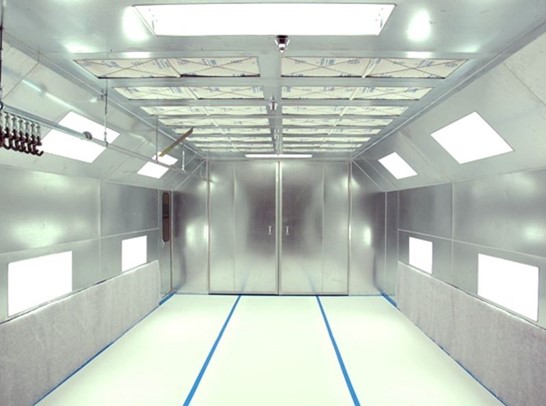
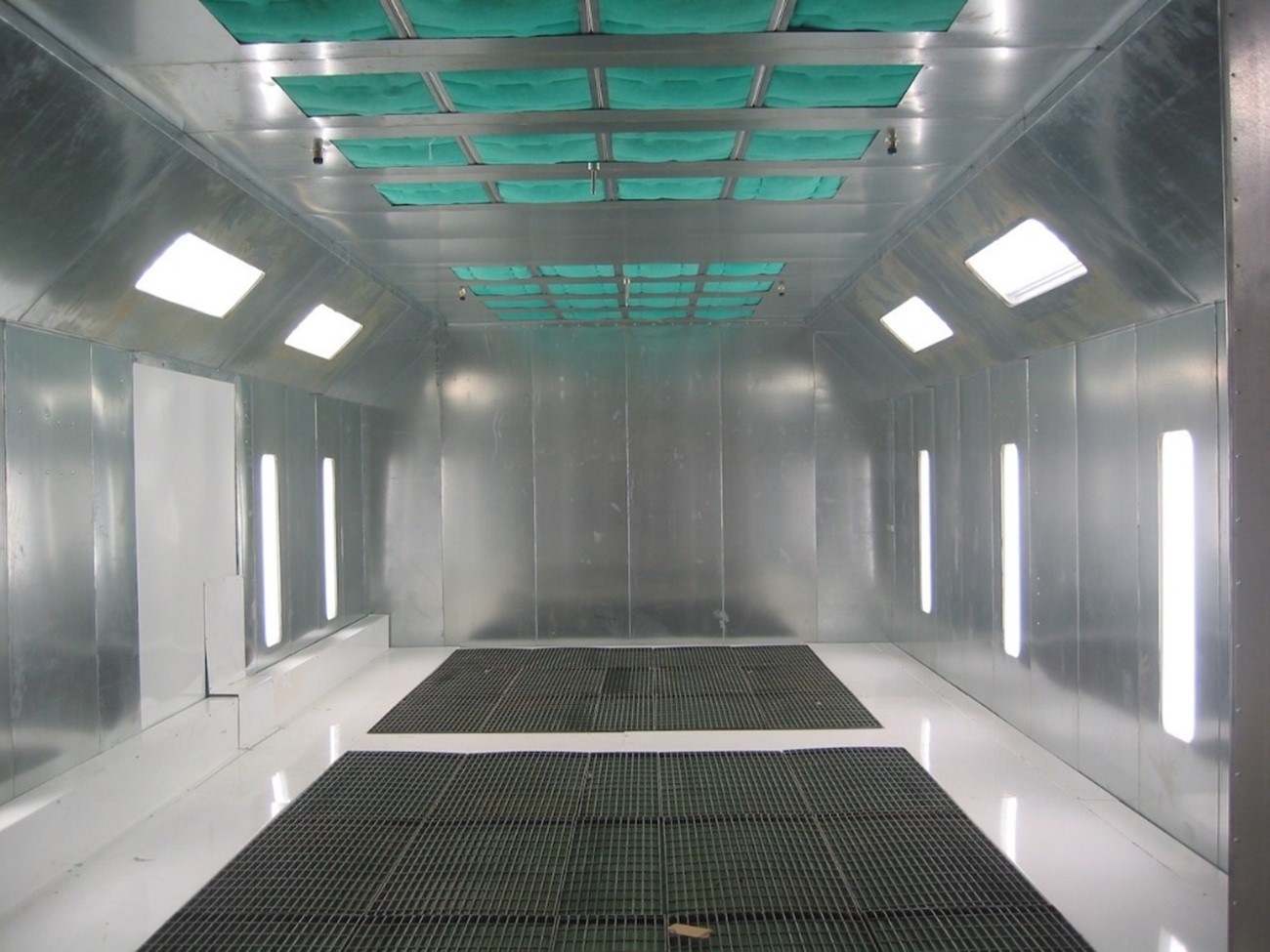
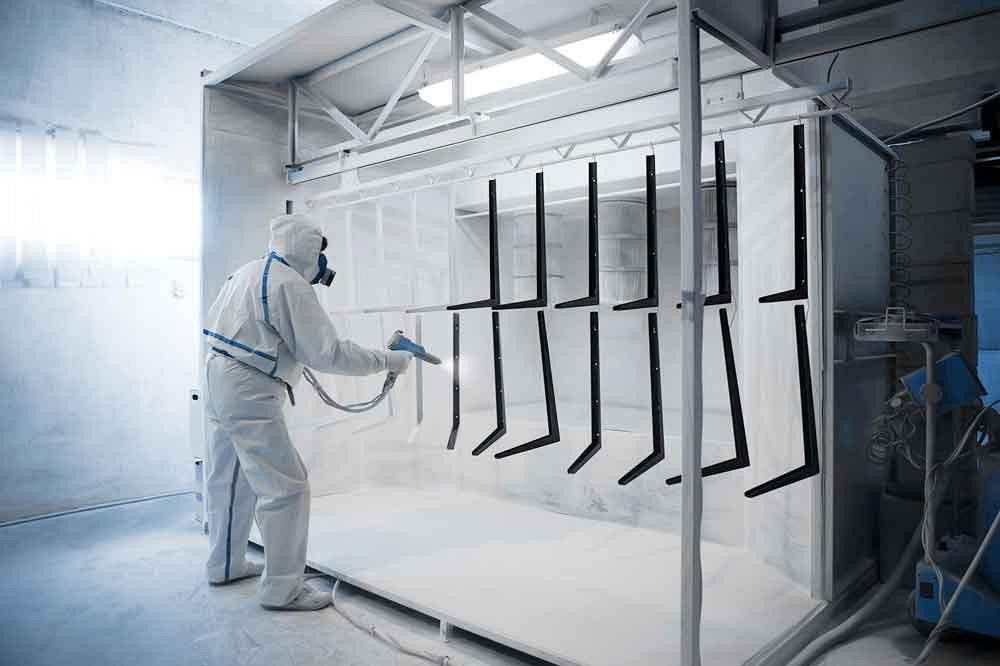
Paint spray booth
VIETNAM CNC & TECHNOLOGY APPLICATION JOINT STOCK COMPANY
Hotline: +84.916 63 9355 / +84.915 74 4664
Email: Sales01@cncvina.com.vn / Sales03@cncvina.com.vn
Product description

What is a paint spray booth?
A paint spray booth, also referred to as a spray booth or painting booth, is a specially designed enclosure used for paint spraying operations. It is designed to control the spraying environment while containing and removing overspray and airborne substances generated during the painting process. A paint spray booth provides a controlled space for applying a coating to the surface of a workpiece, where factors that may affect coating quality can be managed. Paint spray booths are used across a wide range of industries and are available in various sizes and configurations to accommodate different applications, including automotive, marine, aerospace, furniture, and machined components.
Achieving a high-quality and uniform coating requires careful control of several factors during the spraying process, including temperature, air quality, and the spraying equipment and method. Overspray is generated during paint application and, if not properly controlled and collected, can affect the quality of the coating being applied, contribute to airborne emissions, and expose operators to paint-related substances. For industrial applications requiring consistent coating quality and production efficiency, proper control of these factors is therefore an important function of the paint spray booth.
Paint spray booths can generally be configured as fully enclosed booths or open-front booths. A fully enclosed spray booth is enclosed by doors or walls on all sides, while an open-front spray booth has an open front without a door or wall. Depending on the production requirements, a paint spray booth can be designed as a standalone system or integrated into an automated coating line.

Components of a paint spray booth
Filtration system
The filtration system is an important component of a paint spray booth. It helps control the quality of both the incoming and exhaust air within the spray booth. For incoming air, filtration is used to remove dust and other airborne contaminants, while temperature and humidity may be controlled as required by the coating process to maintain suitable spraying conditions and support consistent coating quality.
For exhaust air, the filtration and air treatment system is designed to capture overspray, airborne coating particles, and other substances generated during the painting process. Depending on the type of coating and process requirements, additional treatment equipment may be required to address solvent vapors or other emissions. The filtration and treatment configuration should therefore be selected according to the coating system, airflow rate, production conditions, and applicable environmental requirements.

Air filtration and treatment system
The air filtration and treatment system is designed to control the quality of the incoming air and collect overspray and other contaminants generated during the spraying process. Depending on the coating type, spraying method, and product quality requirements, the system can be configured with different filtration stages and air treatment equipment.
Supply air filter: The supply air filter removes dust and airborne contaminants before the air enters the paint spray booth. Controlling the quality of the incoming air helps prevent dust and contaminants from entering the spraying area, thereby reducing the risk of surface defects in the coating film.
Exhaust air filter: Exhaust air filters are installed in the exhaust air path to capture overspray, paint particles, and other airborne substances generated during spraying before the air is transferred to further treatment or discharged to the environment. The filter configuration should be selected according to the coating type, characteristics of the pollutants, and exhaust air treatment requirements of the system.
Air conditioning and treatment system: This system is used in coating lines where environmental conditions within the spraying area need to be controlled. Depending on process requirements, the system can regulate parameters such as temperature, humidity, airflow rate, and air pressure. Maintaining stable air conditions helps support more consistent spraying, drying, and curing processes.
Therefore, the air filtration and treatment system should be designed as an integrated part of the spray booth, air supply system, exhaust system, and exhaust air treatment system. Equipment selection should not be based solely on airflow rate, but should also take into account the coating type, production volume, spraying method, and product quality requirements.
Airflow control system
Controlling airflow rate, direction, and distribution is an important requirement in the design of a paint spray booth. The airflow should be organized in a suitable direction to carry overspray and airborne substances generated during spraying toward the collection area while minimizing airflow reversal or the recirculation of overspray into the product zone. A properly designed airflow system can improve filtration efficiency, reduce unwanted paint deposition inside the booth, and minimize the risk of overspray returning to the product surface. This is particularly important for products with demanding appearance requirements, where airflow stability can have a significant effect on coating uniformity and overall surface quality.
Depending on the spray booth configuration, product characteristics, and process requirements, airflow can be arranged in different patterns, with common configurations including horizontal airflow, vertical airflow, and combined airflow.
Horizontal airflow: Supply air enters the spray booth from one side, moves horizontally across the product area, and is collected on the opposite side through the exhaust and filtration system. This configuration can be considered for spray booths where the product layout and operator access are compatible with a horizontal airflow direction.
Vertical airflow: Air is supplied from the upper section of the spray booth and moves downward before being collected in the lower section. This configuration can help carry overspray and airborne particles away from the working area and is suitable for certain spray booth designs requiring vertical airflow control.
Combined airflow: This configuration combines characteristics of horizontal and vertical airflow to create an airflow pattern appropriate for the booth geometry, product position, and overspray collection requirements. It provides greater flexibility for systems with specific floor-space constraints or specialized product configurations.
The airflow configuration should be designed in coordination with the booth dimensions, supply and exhaust airflow rates, product position, filtration system, and spraying method. A single airflow pattern should not be applied universally to every spray booth, as ventilation performance also depends on the characteristics of each system and its actual operating conditions.
Lighting system
The lighting system does not directly create the coating film, but it has a significant impact on product visibility and quality control during the painting process. In manual spray booths, appropriate lighting enables operators to clearly observe the surface, control the spray coverage, and identify conditions such as insufficient coating, excessive coating, or uneven coverage. In automated painting systems, robots perform spraying according to programmed parameters, so lighting does not directly determine the spray trajectory. However, suitable lighting should still be provided in operating and inspection areas to support visual inspection, surface quality checks, and equipment maintenance. When designing the lighting system for a paint spray booth, factors such as illuminance, uniformity, light source characteristics, installation position, and the number of lighting fixtures should be considered. Lighting fixtures should be positioned to minimize dark areas and reduce glare or reflections that could interfere with surface inspection.
In addition to visibility requirements, lighting fixtures and electrical equipment installed inside or near the spraying area must be selected according to the environmental conditions and safety requirements of each system. In particular, for spray booths using solvent-based coatings or materials capable of generating flammable vapors, the risk of ignition sources must be considered and electrical equipment suitable for the installation area should be selected. A properly designed lighting system not only supports operators in controlling the spraying process but also improves the detection of surface defects, thereby supporting more consistent product quality control.

Paint spray booths are designed in accordance with applicable standards and requirements to support effective operation while protecting the environment and the health and safety of painting personnel. The performance and suitability of a paint spray booth are commonly evaluated based on five key criteria:
Air quality: A properly designed paint spray booth should maintain suitable supply and exhaust air conditions to support coating quality and control airborne emissions. Exhaust air containing overspray, chemicals, solvents, or other contaminants must be appropriately captured and controlled to minimize exposure to operators and prevent uncontrolled release into the surrounding environment.
Fire and explosion safety: Painting processes may involve flammable coatings, solvents, and vapors. The paint spray booth should therefore incorporate appropriate ventilation, filtration, and safety measures to control flammable substances. Potential ignition sources, including heating systems, lighting, and electrical equipment, must be properly assessed and controlled. Depending on the system and applicable requirements, fire detection, alarm, and suppression measures may also be required.
Safety regulations and standards: The design and installation of a paint spray booth should comply with applicable safety regulations and technical standards covering factors such as construction materials, booth dimensions, working space, ventilation, filtration, electrical equipment, and air treatment systems.
Paint storage and handling: A paint spray booth system may be accompanied by dedicated areas or equipment for paint storage and handling. Paint and related materials should be stored appropriately to minimize the risk of leakage, spills, or uncontrolled environmental release. For liquid paint systems, a dedicated paint mixing area may be provided to support safe preparation and handling of coating materials.
Maintenance: Regular inspection and maintenance are essential for maintaining the safe and stable operation of a paint spray booth. Ventilation systems, air ducts, fans, filters, and other continuously operating components should be inspected periodically and repaired or replaced when necessary to maintain proper operating conditions and safety throughout the painting process.
Water-based paint spray booths and powder coating booths
Two commonly used coating methods are wet painting and powder coating. Since these two processes use different coating mechanisms and application methods, their spray booth configurations and technical requirements also have certain differences.
Water-based paint spray booth
The filtration and air treatment configuration of a water-based or liquid paint spray booth differs from that of a powder coating booth because the overspray generated during liquid paint application is in the form of liquid droplets or aerosols rather than dry powder particles. Depending on the paint system and booth configuration, overspray is captured by suitable filtration or collection equipment and is generally not recovered for reuse in the same manner as powder coating material. Liquid paint spraying can require substantial airflow to maintain suitable booth conditions and control overspray. Therefore, the supply and exhaust air systems must be designed according to the booth dimensions, spraying method, coating characteristics, and required airflow rate rather than using a fixed capacity for all applications.
Water-based and other liquid coating systems may require drying or curing after application. Depending on the coating formulation and process requirements, the spray booth or downstream section of the coating line may be integrated with a flash-off area, drying system, or temperature-controlled treatment stage to prepare the coated product for subsequent finishing processes.

Powder coating does not use volatile solvents in its dry powder form, so the filtration system primarily focuses on capturing and controlling excess powder before the exhaust air is discharged. In powder coating booths, filtration can be configured with cartridge-type collection systems or multi-stage filtration systems, depending on the coating material and process requirements. With a cartridge-type collection system, excess powder generated inside the spray booth can be collected and, where the powder type, color, cleanliness, and process conditions permit, potentially recovered for reuse. With a multi-stage filtration system, multiple filtration stages are installed within the exhaust air filtration system to capture excess powder before the air is discharged to the environment. Depending on the filtration configuration and powder handling process, the collected powder may not be suitable for reuse or may be difficult to recover for subsequent coating operations.

Selecting a suitable paint spray booth
Selecting a suitable paint spray booth requires consideration of multiple factors, including product dimensions, coating type, spraying method, production volume, surface quality requirements, and available factory space. A properly designed spray booth should not only provide sufficient working space but also ensure adequate ventilation, overspray collection, and stable operation throughout the production process.
Paint spray booth dimensions
Dimensions are among the first factors to determine when designing or selecting an industrial paint spray booth. Depending on the products to be processed, manufacturers can select different booth sizes and configurations to meet requirements for working space, production capacity, and spraying methods. First, the maximum dimensions of the product should be determined, including length, width, and height. For products transferred into the booth by conveyor, trolley, or overhead hanging fixture system, additional space must be allowed for the conveying equipment and workholding fixtures.
In addition to product dimensions, the spray booth should provide appropriate clearance between the product, booth walls, spraying equipment, and other related components. This clearance must accommodate operator access and the movement of spray guns or robots while also supporting proper airflow distribution inside the booth. For manual spray booths, the internal space should allow operators to move, spray, and inspect product surfaces conveniently. For automated spray booths or booths integrated with robots, the design must also account for the robot's operating envelope, spray gun position, product travel path, and accessibility to the surfaces requiring coating.
In addition to the internal booth dimensions, manufacturers should consider the space required for filtration equipment, exhaust fans, ductwork, control cabinets, and auxiliary equipment. The installation footprint, maintenance access, and required safety clearances between the spray booth and surrounding areas should also be determined according to the equipment configuration and applicable project requirements. Therefore, a fixed allowance should not be applied universally to every type of paint spray booth. The final booth dimensions should be calculated based on the product, spraying method, conveying equipment, operator access requirements, and selected ventilation solution.
Filtration and airflow control system
The filtration and airflow control system plays an important role in collecting paint mist, limiting overspray dispersion, and maintaining suitable working conditions inside the spray booth. Depending on the coating type, spraying method, production volume, and exhaust treatment requirements, different collection and filtration solutions can be used.
Common paint filtration and collection systems
Dry filter spray booth
A dry filtration system uses filter media to capture paint mist and coating particles generated during spraying. Air containing paint mist passes through the filter, where the coating particles are captured before the air continues through the exhaust and air treatment system. Dry filter spray booths offer a relatively flexible configuration and can be suitable for various manual spraying applications and certain production systems with an appropriate overspray load. The filter media should be selected according to the coating type, characteristics of the paint mist, airflow conditions, and operating requirements of the system.
Water wash spray booth
A water wash spray booth uses a water flow or water curtain to assist in capturing paint mist generated during spraying. Air containing paint mist passes through the collection area, where the paint particles come into contact with water and are captured within the system. This solution can be suitable for applications generating relatively high levels of paint mist or requiring continuous overspray collection. During the design stage, the water circulation system, pumps, collection tank, paint separation equipment, and wastewater treatment solution should be selected according to the type of coating used and the requirements of the project.
Venturi spray booth
A Venturi spray booth uses a high-velocity airflow configuration in the collection area to help entrain and separate paint mist from the airstream. Depending on the design, the system can be combined with downstream paint collection or air treatment equipment. Venturi systems are commonly considered for industrial spraying applications requiring high production capacity and effective overspray collection. Selection should be based on the coating type, paint mist generation rate, exhaust treatment requirements, and overall spray booth configuration.
High-production powder collection spray booth
For powder coating booths, the collection system is designed to control powder particles generated during spraying and, depending on the equipment configuration, support the recovery or treatment of excess powder. High-production systems may use multiple filtration stages, combining primary and fine filtration to improve collection efficiency. The design should take into account the characteristics of powder coating particles, potential powder accumulation, filter cleaning requirements, and applicable safety requirements related to combustible dust.
Airflow control systems
The airflow control system in a paint spray booth is designed to maintain the desired air movement pattern, support overspray collection, and control working conditions within the spraying area. The system configuration should be selected according to the coating type, spraying method, and process requirements of each production line.
Common components include:
| System | Function |
|---|---|
| Exhaust fan | Generates the required exhaust airflow to remove air containing paint mist from the spray booth. |
| Air supply system | Supplies replacement air to the spray booth and supports suitable ventilation conditions. |
| Air ductwork | Transfers air between the spray booth, exhaust fan, filtration system, and related air treatment equipment. |
| Supply air filter | Helps control dust and airborne contaminants in the incoming air, depending on the system configuration. |
| Airflow control device | Supports adjustment and monitoring of ventilation operating parameters according to the system design. |
| Pressure monitoring equipment | Monitors pressure differential or filter operating conditions and can help identify certain operating abnormalities. |
During the design stage, exhaust airflow, supply airflow, airflow direction, and overspray collection performance should be calculated based on actual operating conditions. Airflow control affects not only collection efficiency but also coating quality, the dispersion of paint mist, and safety conditions within the working area.
Crossdraft airflow

Downdraft Airflow control.

Semi-Downdraft Airflow control.

For spray booths requiring a high level of accuracy and coating uniformity, manufacturers can select an automatic painting system or integrate painting robots to control paint application volume, spray trajectory, and coating coverage on the product surface. This solution generally requires a higher initial investment but can improve coating process consistency, reduce dependence on manual operations, and suit production lines with high output requirements.
For products with less demanding technical requirements, lower production volumes, or a need to optimize initial investment costs, a manual spray booth can be a suitable option. The choice between manual and automated spraying should be determined based on the coating type, product dimensions and geometry, production volume, surface quality requirements, available factory space, and the overall level of automation of the production line.
Key considerations when designing a paint spray booth
Regulations and safety requirements
Standards and regulations related to paint spray booth design
Paint spray booth design should take into account requirements related to machinery safety, fire protection, ventilation, paint vapor control, and environmental protection. The system should be configured according to the coating type, spraying method, material characteristics, available installation space, and production scale. For projects in Vietnam, the applicable standards and technical regulations should be determined based on the specific equipment configuration, coating materials, and project requirements. In addition to technical standards applicable to painting equipment, the design should be reviewed against current requirements related to occupational safety, fire prevention and firefighting, electrical systems, ventilation, and environmental protection. Therefore, a single standard configuration should not be applied to every type of paint spray booth. Equipment sizing and selection should be considered from the design stage to ensure stable operation and compatibility with actual factory conditions.
Fire prevention and firefighting safety solutions for paint spray booth design
The spraying area may generate solvent vapors, paint mist, and other potentially flammable substances depending on the coating type and process used. Therefore, safety measures should be incorporated into the design from the beginning rather than added only after installation.
Key considerations may include:
- Positioning the paint spray booth appropriately within the production layout, including required safety clearances and separation from heat sources or potential ignition sources.
- Designing suitable exhaust and air supply systems to control the concentration of paint mist, solvent vapors, and other airborne substances within the working area.
- Selecting electrical equipment, exhaust fans, motors, and other related equipment suitable for the operating conditions of the spraying area.
- Providing fire detection and fire protection or suppression systems according to project requirements and applicable fire safety regulations.
- Selecting materials and structural components suitable for the thermal, chemical, and safety conditions of the paint spray booth.
- Providing appropriate access routes, doors, and means of egress in accordance with the overall factory layout.
For systems using solvent-based coatings, particular attention should be paid to controlling potential ignition sources, ventilation, and exhaust air treatment. For powder coating systems, requirements related to powder dust control and the potential fire and explosion hazards associated with combustible dust should also be considered during the design stage.
Airflow and ventilation system
Importance of airflow in a paint spray booth
Airflow is one of the key factors affecting the operating performance of a paint spray booth. A properly designed ventilation system helps control paint mist, solvent vapors, and other substances generated during spraying while supporting stable working conditions for operators and equipment. For industrial spray booths, exhaust airflow, supply airflow, airflow direction, and the positions of fans and filters should be designed and calculated as an integrated system. If the airflow is not properly configured, paint mist may be distributed unevenly, affecting surface quality and increasing unwanted paint deposition inside the booth.
Factors to consider when designing the ventilation system
Effective ventilation design should consider the following factors together:
- Spray booth dimensions and the volume of space requiring ventilation.
- Product dimensions, geometry, and positioning inside the booth.
- Coating type, solvents, and spraying method used.
- Required supply and exhaust airflow rates.
- Airflow direction inside the spray booth.
- Exhaust fan capacity and filtration system characteristics.
- Paint mist and powder collection performance, as well as downstream exhaust air treatment requirements.
- Temperature, humidity, and environmental conditions at the installation site.
These parameters should be calculated according to the actual configuration of each project rather than applying a fixed value to every type of paint spray booth.
Dimensions and space layout
Determining suitable spray booth dimensions
Paint spray booth dimensions should be determined based on the maximum product dimensions, the method used to transfer products into the booth, the operating range of operators or robots, the position of spraying equipment, and ventilation requirements. In addition to the space occupied by the product, sufficient working clearance between the spray gun, robot, or spraying equipment and the product surface should be considered. For automated production lines, the robot's operating envelope and the movement path of the conveying system should also be calculated during the design stage to prevent interference points or restrictions on the operating range.
Equipment arrangement and workspace organization
The spray booth layout should be coordinated with the entire production process, from product entry, positioning, and painting to overspray collection and product exit. Equipment such as exhaust fans, filtration systems, ductwork, control cabinets, lighting systems, and spraying equipment should be arranged appropriately to facilitate operation, inspection, and maintenance. For integrated coating lines, the spray booth layout should also be coordinated with the conveyor system, fixtures, and upstream and downstream processes. This helps minimize intermediate handling, reduce product transfer time, and support a stable production flow.
Lighting and visibility
Importance of the lighting system
Proper lighting enables operators to clearly observe product surfaces during spraying and identify areas with insufficient or excessive coating, runs, or other surface defects. For products with demanding appearance requirements, the lighting system should be arranged to minimize dark areas and reflections that could interfere with surface observation and coating quality inspection.
Selecting lighting equipment for a paint spray booth
Lighting equipment should be selected according to the working conditions inside the spray booth while meeting applicable electrical safety and environmental requirements. The position, illuminance, and direction of the lighting should be determined based on the booth dimensions, product geometry, and spraying method. For areas requiring strict surface quality control, the lighting system can be designed in coordination with operator workspaces and product inspection positions.
Features of paint spray booths designed and manufactured by CNC VINA
CNC VINA paint spray booths are designed and manufactured according to the actual requirements of each project, with product dimensions, coating technology, production volume, spraying method, and level of automation considered as an integrated system.
Depending on production requirements, the system can be configured as a manual spray booth, automatic spray booth, or spray booth integrated with painting robots. Air supply, exhaust, paint mist filtration, lighting, product conveying, and control systems are designed and calculated according to the overall configuration of the coating line.
CNC VINA focuses on stable operation, convenient maintenance, and effective integration between the spray booth and the pretreatment, drying, painting, and finishing stages. Equipment configuration is selected according to product characteristics and process requirements rather than applying a fixed model to every project. For manufacturers investing in or upgrading a coating system, selecting the appropriate spray booth configuration from the beginning is important for coating quality, production capacity, and long-term operating costs. CNC VINA provides consultation, design, and manufacturing services for customized industrial coating systems according to the production scale and available factory space of each plant.
Customers can also refer to other coating systems and production lines supplied by CNC VINA:
- Pretreatment system for coating lines
- Plastic coating line
- Metal coating line
- Powder coating line
- Automatic coating line
- Automotive coating line
If your company is looking for a paint spray booth or planning to invest in a customized industrial coating line, CNC VINA can provide consultation on a suitable solution based on the product type, coating technology, production capacity, and actual factory conditions.
VIETNAM TECHNOLOGY APPLICATION & CNC JOINT STOCK COMPANY
Factory: Song Cung Industrial Cluster, Dong Thap Commune, Dan Phuong District, Hanoi, Vietnam
Office: Rox Tower (Rox Center Goldmark City), 136 Ho Tung Mau Street, Phu Dien Ward, Hanoi, Vietnam
Tel: +84 916 639 355 / +84 915 744 664
Website: www.cncvina.com.vn | www.cncviname.com.vn


